Why Warehouse Productivity Programs Lose Momentum
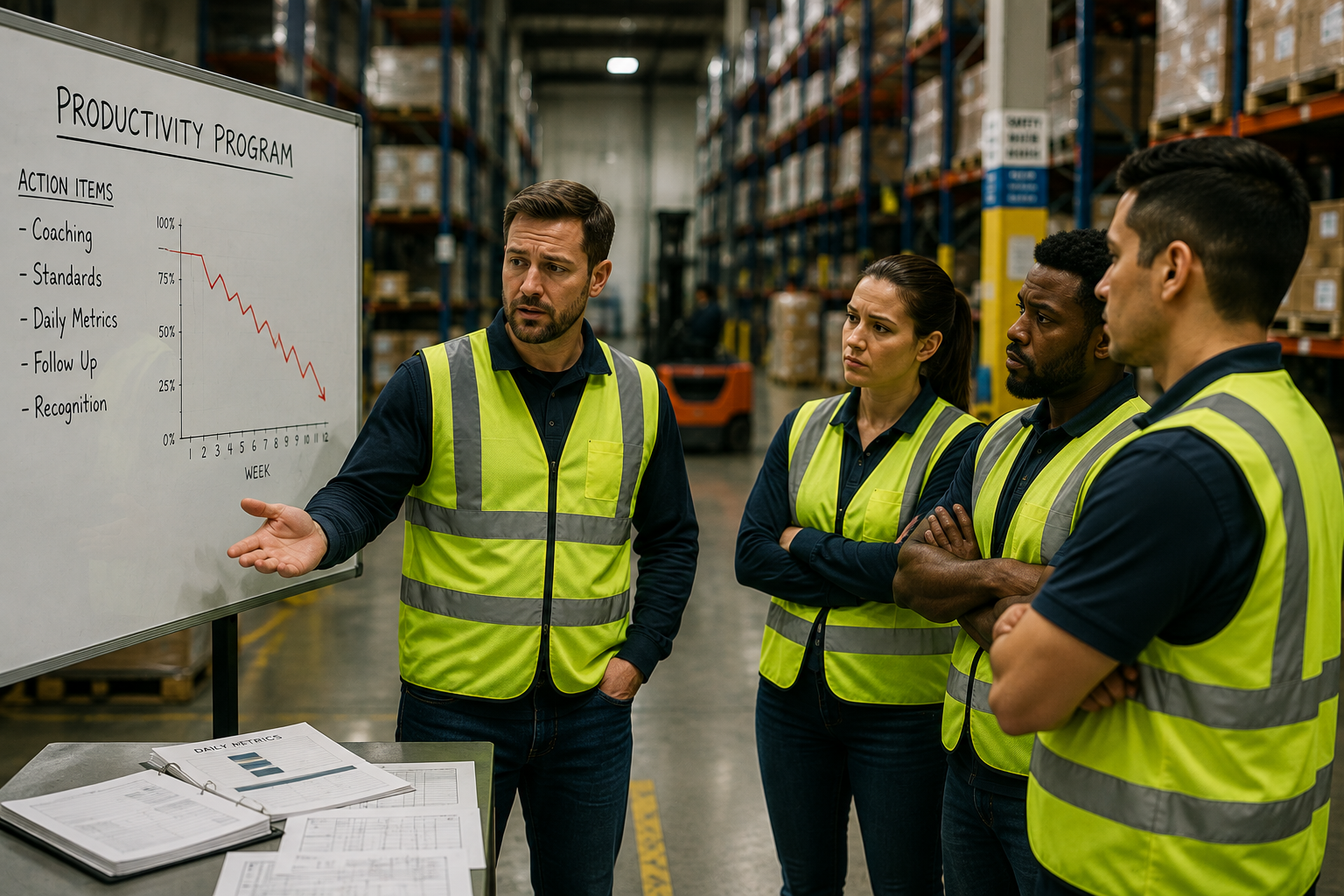
The launch is usually the easy part
Performance improvement programs often begin with energy. There is a project team, a target, executive attention, training, dashboards, and a clear sense that something important is changing.
Then normal operations return. Volume spikes. Leaders change roles. A system issue takes priority. The CI resource gets pulled into another project. The dashboard is still there, but the conversations become less frequent. Coaching slips. Exceptions are tolerated. Six months later, leaders wonder why the original improvement has flattened or reversed.
This is not unusual. It is what happens when improvement is implemented as a project instead of embedded into the operating system.
Performance decays when routines become optional
A sustainable warehouse productivity program depends on boring consistency. Start-up happens on time. Leaders review the same critical signals. Supervisors spend meaningful time where the work occurs. Coaching happens while the event is still relevant. Problems are assigned and followed through. Standards are maintained. New leaders are trained into the system.
None of those activities is dramatic. Together, they create the conditions for sustained performance.
Common reasons momentum fades
Ownership lives with a project manager instead of line leadership.
The organization measures outcomes but not the management behaviors that produce them.
Supervisors do not have protected time or clear priorities for coaching and floor engagement.
Performance meetings become reporting meetings instead of decision-making meetings.
Recurring process barriers remain open until employees stop believing anything will change.
Training is concentrated at launch and does not account for turnover or promotions.
Leadership changes introduce different expectations by building, shift, or manager.
The program has no formal mechanism for recalibration, audit, or continuous improvement.
Measure the system, not only the result
Productivity, labor cost, quality, and service are outcome metrics. They matter. But if the only conversation is about the outcome, leaders may not know whether the management process behind the outcome is healthy.
Leading indicators can be surprisingly simple. Are supervisors on the floor? Are start-up routines being executed? How many meaningful performance conversations occurred? Are unresolved barriers aging? Are CI ideas being submitted and closed? Are standards and methods current? Are managers observing supervisors and coaching the coaches?
These measures make the operating system visible.
Build escalation into the program
One of the quickest ways to undermine a performance culture is to repeatedly coach employees for losses they cannot control. If work is unavailable, equipment is unreliable, replenishment is late, the slotting profile is poor, or a system transaction creates delay, those issues need a path to ownership.
A mature performance program distinguishes employee-controllable opportunity from systemic opportunity. Both matter, but they require different responses. The first may require training, coaching, or accountability. The second requires operational problem solving and escalation.
Sustainability is a leadership design problem
When a program depends on one passionate leader, analyst, or consultant, it is fragile by definition. Sustainability comes from making the desired behaviors part of the normal management system: role expectations, meeting cadences, supervisor routines, manager standard work, onboarding, reporting, goals, and recognition.
The goal is not to keep the initiative alive. The goal is to make the initiative disappear because the new way of working has become simply how the building operates.
The takeaway
Organizations sustain performance when the behaviors that created the improvement are embedded into normal management. The question is not whether the initiative is still active; it is whether the operating routines remain healthy without special project attention.
If performance improved after a launch and then plateaued or slipped, a sustainability review can identify which operating routines have weakened.