Why Labor Management Systems Fail to Deliver Expected ROI
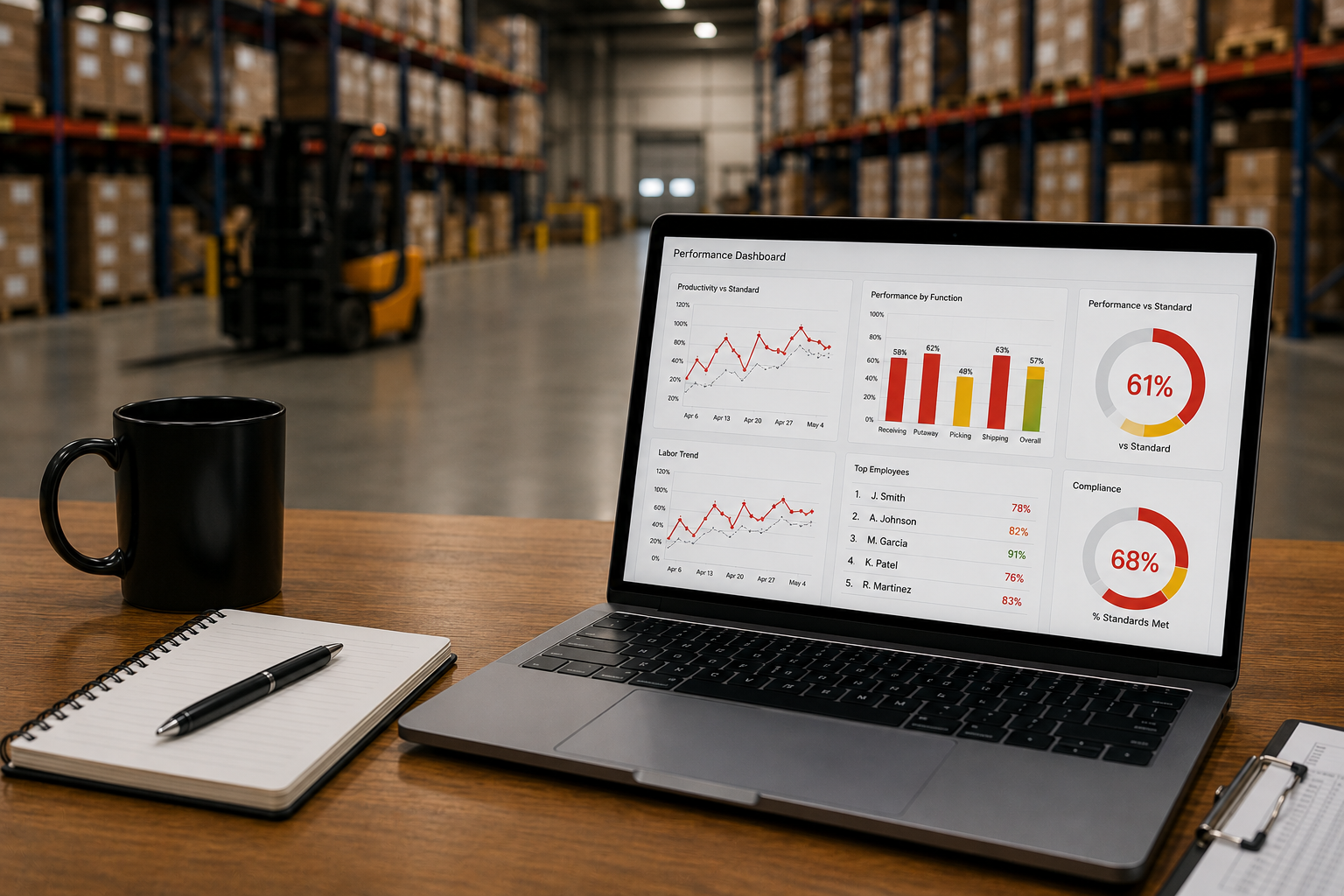
Buying an LMS is not the same as building a labor management program
For more than a decade, I have worked with companies implementing, selling, supporting, and trying to extract value from labor management systems. One pattern shows up again and again: organizations buy the technology expecting the technology to create the operating discipline.
It cannot. A labor management system can measure performance, compare actual work to an engineered or configured expectation, identify trends, and give supervisors better information. Those capabilities are powerful. But the system cannot decide what good leadership looks like on a Tuesday afternoon when orders are behind, three associates are struggling, and a supervisor has a dozen competing priorities.
That distinction matters because many disappointing LMS outcomes are diagnosed as software problems when the real gap is the operating program around the software.
The software answers important questions. It does not perform the management work.
A mature LMS can help answer questions that are difficult to answer reliably with traditional productivity reporting: Who is consistently above or below expectation? Is a performance issue tied to a person, a process, a work area, a shift, or an input problem? Where is indirect time accumulating? Are standards being applied consistently? How much opportunity exists in a specific function?
Those insights are enormously valuable. But someone still has to act on them. A supervisor must understand the data, validate what happened on the floor, determine whether the issue is skill, process, behavior, planning, or system design, and then have a useful conversation with the employee. The next day, the supervisor has to follow up.
If those routines do not exist, the LMS becomes a very sophisticated reporting system.
Why LMS implementations often underperform
The implementation project naturally focuses on configuration: standards, interfaces, data mapping, job codes, reporting, testing, and go-live. Those are necessary. The danger is assuming that go-live is the finish line.
Leaders have not agreed on what the data will be used for and what it will not be used for.
Supervisors are trained on screens but not on coaching conversations.
There is no defined cadence for reviewing performance and following up.
Operational barriers are visible in the data but are never assigned an owner.
Managers tolerate different expectations by shift or department.
Employees experience the LMS as surveillance rather than as part of a fair, transparent performance system.
Leadership attention fades after implementation and the program becomes one more report to review.
None of those are software defects. They are program-design and operating-discipline problems.
A high-value labor management program has several layers
I think about LMS value in layers. The technology is one layer, not the entire stack.
Credible expectations. Employees need to understand what good performance looks like and believe the standards are achievable and consistently applied.
Accurate data. The system needs enough integrity that supervisors and employees trust what it is telling them.
Visible performance. The right information should reach the right level quickly enough to influence today’s work, not just explain last month.
Leader routines. Supervisors and managers need defined behaviors: review, observe, coach, remove barriers, recognize, follow up, and escalate.
Employee coaching. Performance conversations should be routine, factual, and developmental—not something that only happens after a problem becomes severe.
Continuous improvement. Repeated losses should produce process work, not repeated coaching for problems employees cannot control.
Executive reinforcement. Leaders must make labor performance part of how the operation is run, not an initiative owned by one analyst or CI manager.
The real ROI comes from changed behavior
An LMS business case often starts with a productivity number: improve direct labor productivity by X percent and reduce annual labor expense by Y dollars. That is useful for evaluating the investment, but the number itself does not explain where the gain will come from.
Productivity improves because hundreds of small behaviors change. Start-up is cleaner. Associates spend less time waiting for work. Supervisors see a problem earlier. Coaching becomes more specific. High performers are recognized. Low performers receive support and accountability. Poor methods are exposed. Indirect work becomes visible. Managers spend less time debating whose spreadsheet is correct.
Those changes create the financial result. The software enables them; the operating program makes them happen.
A better question for leaders
Instead of asking, “Are we using the LMS?” ask, “What management behaviors are different because we have it?”
If the answer is mostly that managers receive new reports, the organization is probably leaving value on the table. If supervisors are spending more productive time on the floor, performance conversations are more frequent and more objective, barriers are being removed faster, and leaders can explain exactly how performance is managed from shift start through end of day, then the system is becoming part of the operating model.
The takeaway
The best LMS implementations do more than install a measurement platform. They change the way leaders run the operation. If the management routines, coaching process, standards, and improvement mechanisms are weak, software adoption alone will not close the gap.
Have an LMS but aren’t seeing the expected results? A focused performance assessment can help separate software issues from process, leadership, and program-design gaps.