What a Culture of High Performance Actually Looks Like in a Warehouse
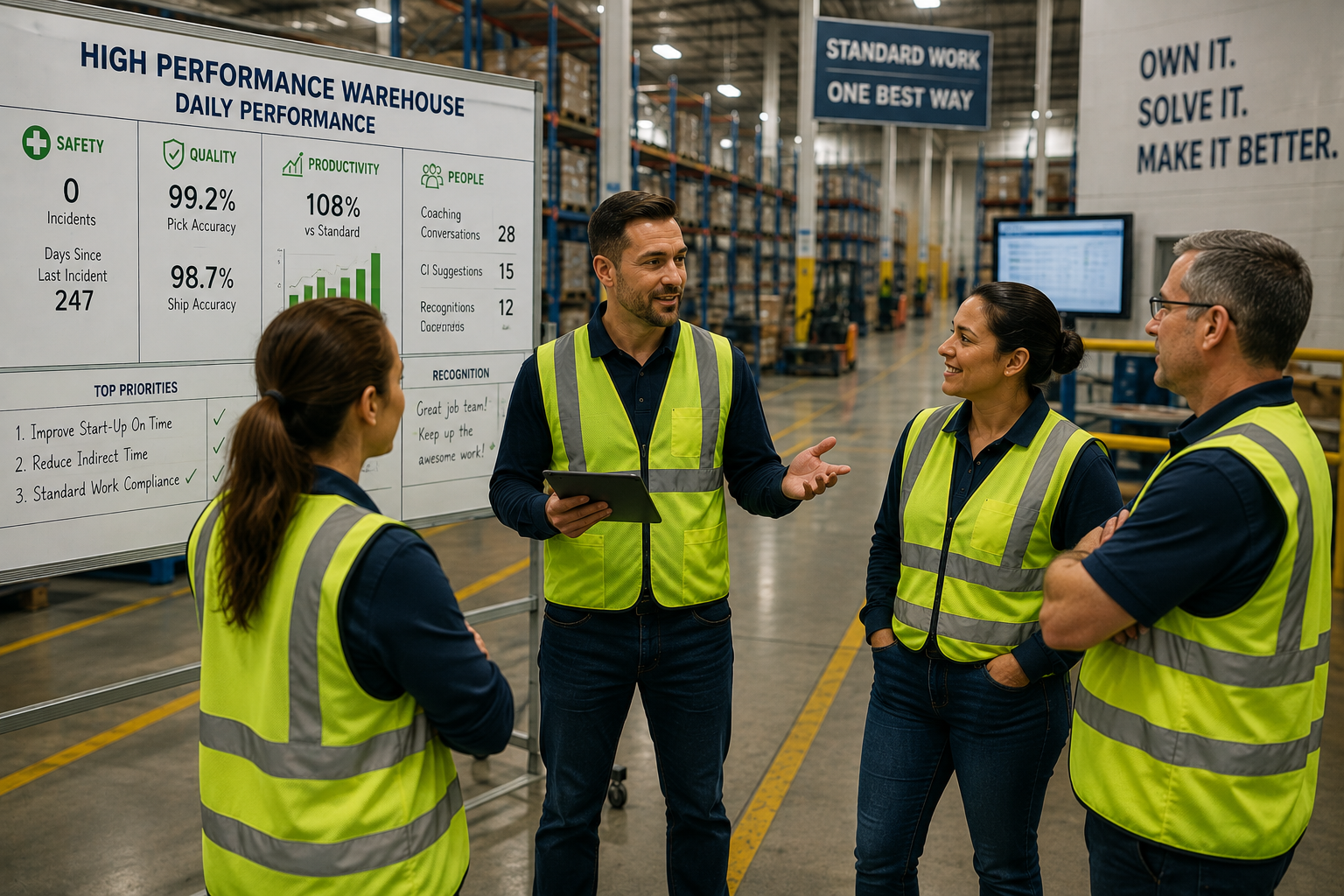
High performance is not a number on a dashboard
When people hear “high-performance culture,” the phrase can sound abstract—or worse, like a euphemism for asking employees to work harder. That is not what I mean by it.
A high-performance warehouse is an environment where people understand what is expected, have a credible method for achieving it, receive useful feedback, see problems addressed, and operate within a management system that reinforces consistency every day.
Productivity is an outcome of that environment. It is not the entire definition.
Leadership creates the conditions
Culture does not build itself from the warehouse floor upward. Leaders establish what matters by what they define, measure, reinforce, tolerate, and solve.
If one shift starts on time and another does not, that is culture. If one supervisor coaches performance and another avoids the conversation, that is culture. If associates repeatedly report a process barrier and nothing changes, that is culture. If managers spend most of the day in meetings while supervisors are left to manage through constant escalation, that is culture.
A high-performance culture requires leadership at every level—not speeches about accountability.
The building blocks of a high-performance warehouse
Clarity. Employees know the standard, the priority, and what good performance looks like.
Standard work. The organization has a defined best-known method and actively maintains it.
Visibility. Performance information is timely enough to influence behavior during the shift.
Floor leadership. Supervisors spend enough time where work occurs to understand reality and coach effectively.
Coaching. Feedback is routine, specific, balanced, and tied to observable behavior and credible data.
Ownership. Problems have owners and recurring barriers do not become permanent workarounds.
Continuous improvement. Employees and leaders are expected to improve the system, not merely operate within its flaws.
Consistency. Expectations do not change depending on which supervisor or shift is working.
Escalation discipline. Issues move to the level that can solve them rather than circulating indefinitely.
Reinforcement. Hiring, onboarding, training, promotion, goals, recognition, and accountability all support the same operating expectations.
People want to succeed—but the system has to let them
Most employees do not arrive at work hoping to fail. Performance problems do exist, and accountability matters. But before labeling a person as the problem, a strong operating system asks whether expectations are clear, the person was trained, the method is achievable, work is available, tools function, and the supervisor has provided useful feedback.
That is not lowering the bar. It is making the bar legitimate.
When employees believe the system is fair and leaders address real barriers, performance conversations become easier because the organization has earned credibility.
Discipline beats heroics
Many warehouses are full of talented people who can rescue the day. They know whom to call, where to find the missing inventory, how to work around the system, and how to push an urgent order through. Those people are valuable—but an operation that depends on heroics is fragile.
High performance comes from making success repeatable. The right work is available. Processes are documented. Escalation is defined. Meetings drive decisions. Supervisors know their routines. Improvement work is visible. The operation does not require extraordinary effort simply to produce an ordinary day.
Technology should support the culture
LMS, WMS, automation, analytics, digital work instructions, and other tools can make a strong operating system much more powerful. They provide visibility, consistency, and scale.
But the technology must support the culture leaders are trying to create. If the organization wants accountability, systems must provide credible data. If it wants continuous improvement, recurring losses need to be visible. If it wants stronger coaching, supervisors need usable information at the point of action.
Technology is part of the journey. It is not a substitute for leadership and operating discipline.
What leaders should be able to see
A high-performance operation should be observable. You should be able to walk the floor and see evidence of it: clear start-up, leaders present in the operation, visual performance information, standard work, clean escalation, coaching, ownership of abnormalities, and people who can explain how their work connects to the building’s goals.
You should also be able to see it in the management system: consistent metrics, defined routines, improvement backlogs, leader development, and follow-through.
That is the essence of a Warehouse Performance Operating System: aligning people, process, leadership, data, and technology so improvement is not dependent on the personality of one manager or the urgency of one initiative.
The takeaway
High performance is created by a system of reinforcing conditions. Leaders set those conditions through clarity, standard work, visibility, coaching, problem solving, consistency, and disciplined follow-through. The goal is not simply higher productivity; it is a stronger operation that can sustain improvement.
Want to understand which parts of your operating system are helping—or limiting—performance? A warehouse performance assessment can establish the baseline and roadmap.